How to start a travel business in Dubai: 11 steps to establish and succeed in 2026
How to start a travel business in Dubai: 11 steps to establish and succeed in 2026
A well-rounded explanation of the processes and considerations to start a travel agency in Dubai.
Vincy Amirtharaj
58 post
Senior Business Setup Consultant, Dubai
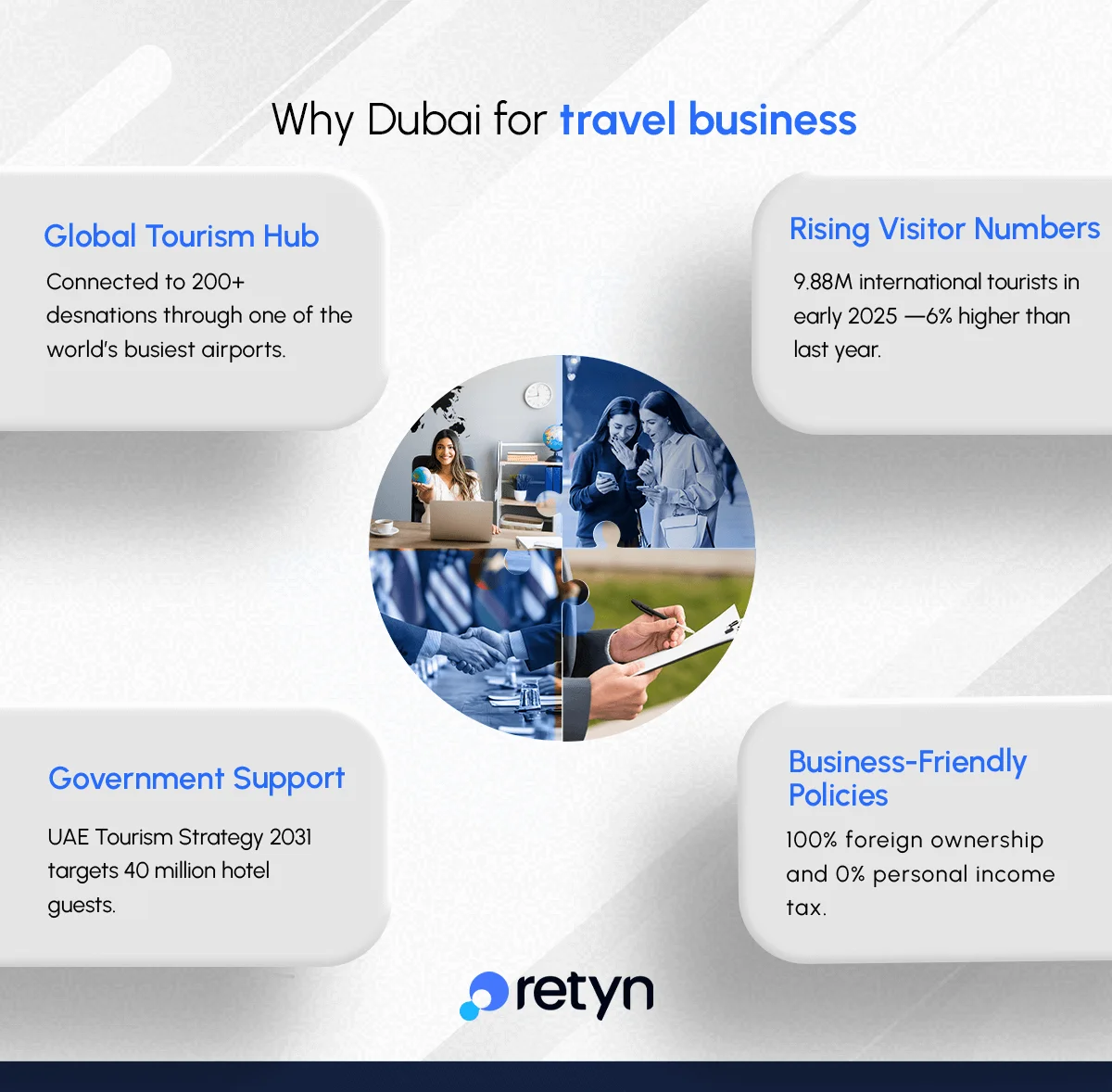
Dubai's ultramodern architecture, climate, hospitality and continuous government support for tourism have made it one of the world's leading tourist destinations. The data provided by the Dubai Department of Economy and Tourism (DET) states that between January and June 2025, Dubai welcomed 9.88 million international overnight tourists. This represents a 6% increase compared to 2024, further illustrating the success of Dubai's tourism and hospitality sectors.
With Dubai’s thriving tourism industry there is immense scope for travel agencies, destination management companies (DMCs), tour operators and travel-tech startups. This guide covers all the important steps and considerations to set up your travel business in Dubai.
Typical 8-week travel-setup timeline
Week
Authority / Task
Key output
1
DET or Free Zone
Initial approval ✓ | Trade-name reservation ✓
2
DET (Tourism)
Initial approval for tourism activity ✓
3
Land Dept / Ejari
Office lease contract → Ejari uploaded
4
IATA
Air-ticketing NOC requested
5
DET
Inbound / outbound travel-agency licence issued ✓
6
Insurer & Bank
Liability cover bound | KYC → Account approval
7
GDRFA
Investor / staff visas stamped
8
DET e-Permit Portal
Marketing-permit portal activated — Go live!
Note: Certain free-zone “express” bundles can compress Weeks 1-5 into ~10 days; banking KYC may extend
Week 6 for high-risk nationalities.
“Dubai’s ability to create compelling experiences that meet the evolving needs of visitors has strengthened its status as one of the world’s most sought-after destinations. From exceptional infrastructure to unique attractions, Dubai offers a model of excellence in the tourism and hospitality sectors grounded in innovation.”
- His Highness Sheikh Hamdan bin Mohammed bin Rashid Al Maktoum, Crown Prince of Dubai, Deputy Prime Minister, Minister of Defence, and Chairman of The Executive Council of Dubai
Step 1: Choose your travel business model
Identify which activity is most aligned with your objectives and which activities are allowed under the scope of operation, of your license. First, review the different categories of travel-related licenses available in Dubai.
Travel agency
Those whose primary focus is on travel booking and sales of airline tickets, hotel stays or other travel-related items.
Destination Management Company (DMC)
Companies offering professional services in the areas of inbound travel and event logistics for large groups and corporate clients.
Tour operator
Could be inbound or outbound. Primarily tour operators design itineraries and sell pre-packaged or customized tours.
Online Travel Agency (OTA)
Selling travel products through digital platforms or mobile applications.
Corporate travel management
Providing planning, booking and managing of all aspects of business travel arrangements, as well as MICE (Meetings, Incentives, Conferences, Exhibitions) services.
Offering licensed, guided travel experiences at numerous points of interest throughout Dubai.
Pro tip
Double check on your revenue source first, either from inbound (travel services within Dubai), outbound (travel services to destinations outside of Dubai) or online (via digital travel platforms). The choice is about to influence the type of travel license and approvals you’ll need later.
Travel-setup cost estimator (AED)
Estimated setup cost: —
Get detailed breakdown on WhatsApp
*Includes AED 1 070 for initial approval (150) + trade-name reservation (920).
Bank guarantees, DTCM security deposits & insurance vary—chat with us for an exact quote.
Step 2: Choose a trade name
Once you have gone through all the DET naming regulations, choose and secure the trade name for your travel agency or tour operator. Regulations require the use of terms that do not offend religious sentiments, politics or state entities. After you pick a name that fits your business operations and is unique within the chosen jurisdiction, you can then register the name with DED for Mainland or the appropriate Free Zone (for example DMCC, IFZA, Meydan, DAFZA) as per your needs. As well, get a domain name and professional email as they will be required by banks and tourism authority.
Quick Fact
International visitation in Dubai saw new heights in 2024 with major industry events, like GITEX Global (200,000 attendees) and Gulfood (150,000 attendees).
Source: Dubai Department of Economy and Tourism (DET)
Step 3: Prepare a business plan
Prepare a business plan to be submitted for travel license approval from the DET. It should define your business model or service types (such as travel packages, online travel agency (OTA) or visa service) and target markets such as the Gulf Cooperation Council (GCC) countries.
A complete plan must also outline:
Adopted marketing strategy (Global Distribution System access, partnerships or online campaigns)
Operations with office setup
Vehicles and software systems needed & hiring plans
Prepare your budget to account for initial costs such as setup, working capital, insurance, and performance guarantee and include it in your submission.
Pro tip
A short version of “bank-ready dossier” with projected transactions and travel supplier contracts might ease the banking process.
Step 4: Select a business structure
UAE has many different types of business legal structures for travel agencies. All have their own advantages and focus areas.
LLC (Mainland)
Popular for its flexibility with regards to business activities and growth potential, as well as for providing protection for shareholder liability.
Sole establishment
Foreign nationals can operate a professional travel agency as a sole proprietorship and be a consultant or tour guide by employing a local service agent (LSA).
Free Zone Company (FZ-LLC/ FZE)
Establish your company within one of the free zones, which offer benefits including 100% foreign ownership without the requirement of a local sponsor. Suitable for OTAs and travel tech start-ups.
Branch office
If an international travel group is expanding into Dubai and does not want to create a new legal entity, it can establish a branch office.
Pro tip
Consider separate licenses or endorsement from DET for each travel activity (inbound, outbound or ticketing purposes).
Build your travel agency with the right foundation
From regulatory compliance to market entry planning, learn how our end-to-end assistance helps new travel entrepreneurs start strong in Dubai.
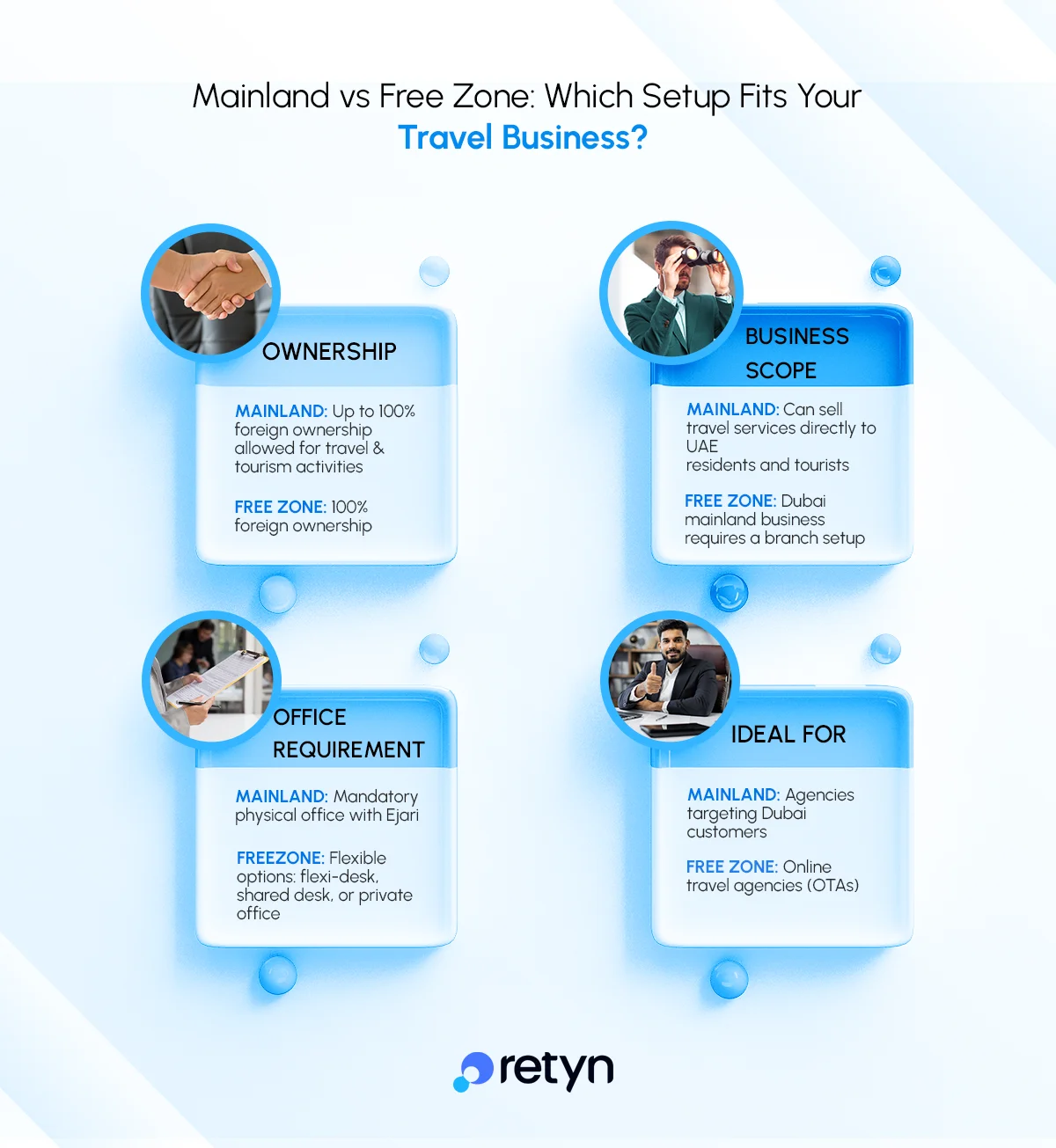
Step 5: Choose your jurisdiction: Mainland vs free zone
The task here is to determine what jurisdiction will best support your chosen activity and ownership structure of your business setup in Dubai, while avoiding any potential regulatory challenges.
Mainland
Mainland business formation in Dubai allows you to sell your services to UAE-based consumers directly from your agency. It is easy to add new activities and partner with local hotels, tour guides or transport operators. Therefore, this jurisdiction is most suited for travel agencies looking to have an onshore presence or open additional physical locations in Dubai.
Key requirements for travel-related mainland licenses:
Tourism approval, issued by DET.
Ejari certificate for confirming the registration of the tenancy agreement.
Professional indemnity (PI) insurance and financial guarantee.
Free zones
Free zones offer a variety of special economic zones (for example, DMCC, IFZA, Meydan, DAFZA, DSO), which have historically been popular among international investors. One of the primary advantages of establishing a free zone company formation in Dubai is the ability to achieve 100% foreign ownership. Other benefits include streamlined administrative procedures when setting up your company, a range of flexible office options available, digital-centric infrastructure and faster visa processing.
An obvious choice for:
Online Travel Agencies (OTAs).
B2B wholesalers and tech platforms.
International DMCs and export-focused firms.
Quick Fact:
Value added by the travel and tourism sector to the GDP of the GCC countries reached $247.1 billion in 2024. By 2034, the numbers are projected to hit $371.2 billion, a 13.3 percent increase.
Source: GCC Statistical Centre
Licence-application document checklist
Mainland LLC / Sole Establishment
Passport & UAE entry stamp (all shareholders)
Emirates ID or UID number
Office lease / Ejari certificate
Initial approval certificate from DET
Manager’s tourism-experience certificate
Bank-guarantee letter (AED 100 K†)
No-objection certificate (if on existing visa)
Initial approval & trade-name certificates
Free zone (e.g., DMCC · DSO)
Passport copy (all shareholders)
Visa / entry stamp or UID number
Shareholder CV + photo
Office or flexi-desk lease agreement
Tourism activity-code selection form
DET* tourism endorsement letter
Proof of address (utility bill or bank statement)
Tip: Scan PDFs at 300 dpi to avoid portal re-uploads. Keep originals for bank KYC, DET site visits, and IATA audits.
sequenceDiagram
participant Founder
participant DED as DED / Free Zone
participant DET as DET (Tourism Licensing)
participant Bank
participant GDRFA
participant Insurer
Founder->>Founder: 1 · Choose travel services (in/outbound, ticketing)
Founder->>DED: 2 · Reserve trade name
Founder->>Founder: 3 · Draft business & feasibility plan
Founder->>Founder: 4 · Select structure
Founder->>Founder: 5 · Lease office & register Ejari
Founder->>DED: 6 · Apply for travel-agency licence
DED-->>Founder: Licence issued
Founder->>DET: 7 · Submit manager credentials + bank guarantee
DET-->>Founder: Tourism approval granted
Founder->>GDRFA: 8 · Immigration & visas
GDRFA-->>Founder: Visas stamped
Founder->>Bank: 9 · Open operating & guarantee accounts
Bank-->>Founder: Accounts approved
Founder->>Insurer: 10 · Professional liability & PI insurance
Insurer-->>Founder: Policy issued
Note over Founder: 11 · Renewals (licence · tourism-classification · visas · VAT)
Step 6: Register your company and obtain a tourism license
In preparation for establishing your travel agency in Dubai, you will need to provide documentation to regulatory agencies for approval. This process is quite similar regardless of whether you choose to register as a mainland or free zone business.
Obtain approval for the specific license, i.e. an inbound tour operator license, outbound tour operator license, or travel agency license.
Get professional indemnity insurance, as it is a requirement when working with clients.
Obtain the trade license and tourism permits from the Department of Economy and Tourism.
Free zone
Check with the free zone websites that you wish to register in, and follow their online application processes (e.g. DMCC, IFZA).
Determine the legal structure of your company (FZ LLC or FZE).
Select travel, consultancy or OTA-related activity codes.
Obtain external tourist approvals if your travel agency is going to be conducting inbound or outbound tours.
Complete your lease agreement, obtain your trade license and complete visa applications.
“Our response has been both deliberate and future-focused: enhancing visitor experiences through technology, investing in high-growth segments such as luxury, wellness, and experiential travel, and promoting deeper cultural exchange through local community engagement. ”
- His Excellency Helal Saeed Almarri, Director General of the Dubai Department of Economy and Tourism (DET)
Step 7: Set up immigration files and plan visas
The first step after getting a license for your new Dubai business will be to obtain the establishment card (also called immigration card). The establishment card proves that your company has been approved by the government to provide sponsorship for investor and employee visas for your employees and investors (travel agents, tour guides, drivers, etc.).
Then set up your GDRFA online portal account (mandatory for mainland companies) to submit all applications quickly and efficiently. In addition to these steps, registration should also take place for Wage Protection System (WPS) for compliance with payroll regulations and Dubai Health Insurance (mandated).
Additional permits may be required from Dubai Tourism and Roads & Transport Authority (RTA), depending on the specific role within your business (i.e. licensed tour guides, drivers, etc.).
Coordinate with the Ministry of Human Resources and Emiratisation (MOHRE) and General Directorate of Residency and Foreigners Affairs (GDRFA) for obtaining the necessary visas and managing immigration matters.
Pro tip
Emiratization applies if you exceed workforce thresholds.
Step 8: Open a corporate bank account
The next step is to open a corporate bank account to conduct all the financial transactions needed to open a new business in Dubai. To do this you are going to need documentation to prove your legitimacy in running a travel operation which includes:
Keep in mind that you produce the following documents:
Come up with a clean dossier showing your inbound or outbound flows, supplier networks and payment gateway setup if operating online. The paperwork preparation and submission steps can be less complicated with corporate bank assistance in Dubai.
Step 9: Secure external approvals and travel-specific permits
In addition to the required approvals by Dubai Tourism (DET) for travel agencies, tour operators and DMCs, there are several other regulatory bodies that require additional approval:
RTA: Regulates all forms of transportation for tourists, vehicle rentals and logistics services in the Emirate of Dubai.
GDRFA: Provides processing for visa and travel documentation services.
Insurance Authority: Is responsible for ensuring that passengers are protected through passenger liability and tour operator insurance.
In addition to these regulatory bodies, OTAs and travel technology companies must also comply with UAE data protection regulations and PCI-DSS (Payment Card Industry Data Security Standard) when making or accepting online payments.
Free 2025 Travel-Compliance Calendar (Excel)
Never miss DTCM licence renewals, IATA agency audits, or bank-guarantee expiry dates again. Tap below and we’ll WhatsApp the Excel sheet instantly.
Step 10: Arrange mandatory insurance and financial guarantees
Obtaining insurance coverage is an important safety net for travel related businesses to protect against unforeseen financial risks. In the UAE, travel businesses must have professional indemnity insurance, passenger liability insurance and vehicle insurance (if they operate tour vehicles). Travel businesses should maintain adequate employee health and workers’ compensation insurance to ensure workplace safety.
Step 11: Stay compliant with renewals, filings and taxes
There will be penalties assessed to the travel agency if either the license renewal for the travel agency and the license renewal for the tour guide is missed for two consecutive years. Please note the deadlines for:
Annual renewal of the DET License.
Renewal of the current insurance policy.
Reporting of UBO, ESR and Corporate Tax as required.
Reporting and payment of VAT returns, if the company exceeds the mandatory registration threshold of AED 375,000 in taxable supplies.
Renewal of RTA and tourism vehicle permits.
Renewal of staff visas and tour guide permits.
Maintenance of current customer complaint records.
Pro tip
A compliance calendar will help you track the timelines for license renewal, visa renewals, VAT/corporate tax, insurance and supplier audits.
Decision snapshot (what to choose, at a glance)
If your priority is…
Likely fit
Selling travel packages in Dubai
Mainland LLC
Running an online OTA or platform
Free Zone (e.g., DMCC, IFZA, DSOA)
Managing inbound tourists (DMC)
Mainland DET-approved DMC license
Providing visa & documentation services
Mainland or specialized free zone
Offering guided tours
DET tour guide + RTA approvals
Picking the wrong activity code (e.g. Inbound vs. Outbound Operator)—DET will reject the application.
Submitting the licence file without the mandatory DET Tourism Manager documents.
Forgetting the AED 100 000 bank guarantee—a prerequisite for travel-agent approval.
Using a virtual office / PO-box only; banks and DET need a verifiable physical address.
Overlooking BSP settlement cycle deadlines—risk of GDS shut-off.
Not updating Data-Protection & PCI-DSS policies while storing passport copies and card details.
Travel regulation & news updates · 2026
VisaUAE introduces new Entertainment Visa - 29 September 2025
The new Visa allows individuals in commercial gaming and entertainment sectors to live and work in the UAE, sponsored by licensed local entities.
VisaUAE introduces Events Visa for short-term entry - 29 September 2025
The new Events Visa allows foreign visitors to attend official events in the UAE on a temporary, sponsor-backed basis with an invitation letter.
VisaMultiple-entry tourism visa introduced for cruise ship - 29 September 2025
New multiple-entry visas enable cruise and leisure boat tourists to enter the UAE with an approved itinerary and licensed operator sponsorship.
Transport RegulationRTA issues new executive regulation - 8 September 2025
New regulation standardises permits for tourist transport establishments, vehicle registration and renewal, and professional driver licensing.
VisaUnified GCC Tourist Visa to launch pilot phase in late 2025 - 29 September 2025
GCC tourist visa will enter pilot rollout in Q4 2025, strengthening regional integration and positioning the Gulf as one unified tourism destination.
ImmigrationUAE now requires passport cover copy for all entry permit applications - 25 Sept 2025
New mandatory requirement for all entry permit applicants to submit the external passport cover page copy, along with supporting documents.
Glossary of acronyms
DTCM - Dubai Tourism & Commerce Marketing
IATA - International Air Transport Association
BSP - Billing & Settlement Plan
GDS - Global Distribution System
NOC - No-Objection Certificate
DET - Department of Economy & Tourism
CT - Corporate Tax (9 %)
TDF - Tourism Dirham Fee
FAQs with answers on how to start a travel business in Dubai
You can choose from many different ways to operate a travel agency in Dubai. You can be either an inbound or outbound tour operator, you can help customers get visas, or offer insurance for their trips. You can also plan a custom event, such as a desert safari or a dinner cruise, or you can work directly with your customers and manage all the logistics, including booking flights and hotels.
No longer, since travel agencies in Dubai are now permitted for 100% foreign ownership in both mainland and most free zones. However, there is still a negative list for certain specialized activities, i.e., corporate contracts with government entities, which would require either a local service agent or sponsor.
You can choose from several options when it comes to obtaining a travel-related license in Dubai.
These include:
Travel agency (inbound/outbound)
Tour operator
Destination Management Company (DMC)
Visa services
Tour guiding services
All travel-related licenses are granted by the Dubai Department of Economy and Tourism (DET). If you are going to be running an OTA (online travel platform), you will obtain a Free Zone license, but, if you are running an inbound tourism operation, you will still need to get DET approval.
Yes, but with limitations. A Free Zone travel company can conduct business either inside the Free Zone or internationally. If you wish to sell onshore travel packages or manage inbound tourism, you will need to obtain either a DET-approved travel activity endorsement or establish a mainland branch.
Yes, you need to provide proof of your travel agency's financial status; this is a requirement of DET.
Vehicle insurance for tour vehicles (if applicable)
This is to ensure that your travel agency complies with regulations, protects your customers and is a requirement to issue a license.
Disclaimer: This content is for informational purposes only and does not constitute legal
advice. Business setup regulations can change. Always consult with a qualified professional for your
specific needs.
Need guidance through the travel business setup process?
Connect with our team for a free consultation to understand licensing, compliance, and setup requirements.